
Manufactured Permanence (pt.2)
the dying art of forgetting

Grief
In college, I read a paper by Dan Moller titled “Love and Death.” In the paper, Moller ruminates on the empirical finding that bereaved spouses recover rather quickly from the death of their loved one. There is substantial evidence to suggest that we as people suffer a lot less than we expect to from the death of loved ones.
He asserts that there is something regrettable about the speed at which we recover; he thinks this says something about how important that person was to us in life, and also that it keeps us from attributing value accurately.
I have some issues with his claims—namely his assertion that grief is contained only in suffering—but I think his logic actually applies well to the issue of griefbots.
Insofar as griefbots are meant to alleviate the suffering of the bereaved, Moller would likely argue this actually disrupts our capacity to suffer for these people and therefore accurately understand their importance.
Consider the husband who, upon the death of his wife, employs a chatbot to continue talking to him in the way his spouse would have. She reminds him to check on his skin tags, to text his children, to go to bed early. She talks about the book she’s reading and her thoughts on the news. Though his wife is gone, some of her old behaviors (accurate or not) still remain.
Simply put, in using a griefbot a loved one’s absence is felt less. If one feels the absence of a loved one less, then they likely miss them less, suffer their loss less, and grieve them differently. I have no reservations in asserting that Moller would find this different grief more shallow.
If we do not suffer, then we do not feel. If we do not feel, then we cannot measure importance.
That’s the general argument, from a suffering-is-important perspective, against the use of griefbots.
But I have more.
Forgetting
There is something far more profound about the act of grieving that I think Moller misses, and that I think is uber-relevant in this case: the act of forgetting.
One of my favorite Wordsworth poems is Surprised by Joy. I’ve pasted it below:
Surprised by joy—impatient as the Wind
I turned to share the transport—Oh! with whom
But Thee, long buried in the silent Tomb,
That spot which no vicissitude can find?
Love, faithful love, recalled thee to my mind—
But how could I forget thee?—Through what power,
Even for the least division of an hour,
Have I been so beguiled as to be blind
To my most grievous loss!—That thought’s return
Was the worst pang that sorrow ever bore,
Save one, one only, when I stood forlorn,
Knowing my heart’s best treasure was no more;
That neither present time, nor years unborn
Could to my sight that heavenly face restore.
Wordsworth curses his own capacity to forget “even for the least division of an hour” this person that he has lost. This moment is the “worst pang that sorrow ever bore” except for the moment of death itself.
I’ve always been struck by the precision with which Wordsworth apprehends this dimension of grief. It is the suffering borne from no longer suffering. A kind of mental rebellion against the psychological resilience that Moller finds so regrettable.
I bring this poem up not to hint at the utility of griefbots in alleviating this particular kind of suffering—rather, I think the poem offers a compelling reason why one ought not to use griefbots, no matter how painful.
For Wordsworth’s speaker, it is “Love, faithful love” that “recalled thee to my mind.” The act of remembrance, of holding on, of noticing absence is an act filled with love. We suffer a loss and suffer our own recovery not because we wish to be alleviated; but because there can be no alleviation of the relevant kind to be found. That which we have loved is lost and it is the extent of our love that reminds us of this.
For the poem’s speaker, to feel joy is to wish to share it with this person. That act of love, in my view, says far more than the resulting pang of sorrow in realizing that they are no longer living.
This is what Moller overlooks, I think. It is not the degree to which we suffer a person’s loss. It is the extent to which joy, love, and existence itself becomes imbued with a reminder of their presence.
Griefbots, in reducing our suffering in grief, also limit our joy in remembrance. That is the most profound loss at stake in using this technology. For all of the psychological damage that we do ourselves and our loved ones in using griefbots, we do far more damage to the individual we have lost.
We confound our notion of who they were, how they existed, and the aspects of life intertwined with their being with an artificial reconstruction of their most visible parts.
I think I’m stuck in word salad here, so it might be useful to use an example.
Recently, I went to the CaixaForum in Madrid where I saw the “Desenfocado” (or ‘unfocused’) exhibit put on there. As I understood it, the exhibit puts an emphasis on the intentional blurring and abstraction of art, the discomfort often felt with that, and the meaning and imaginative value that blossoms from it.
It begins with a quote from Gaston Bachelarand (translated into English): “The value of an image is measured by the extent of its imaginary aura. We could say that a stable and completely realized image clips the wings of the imagination.”
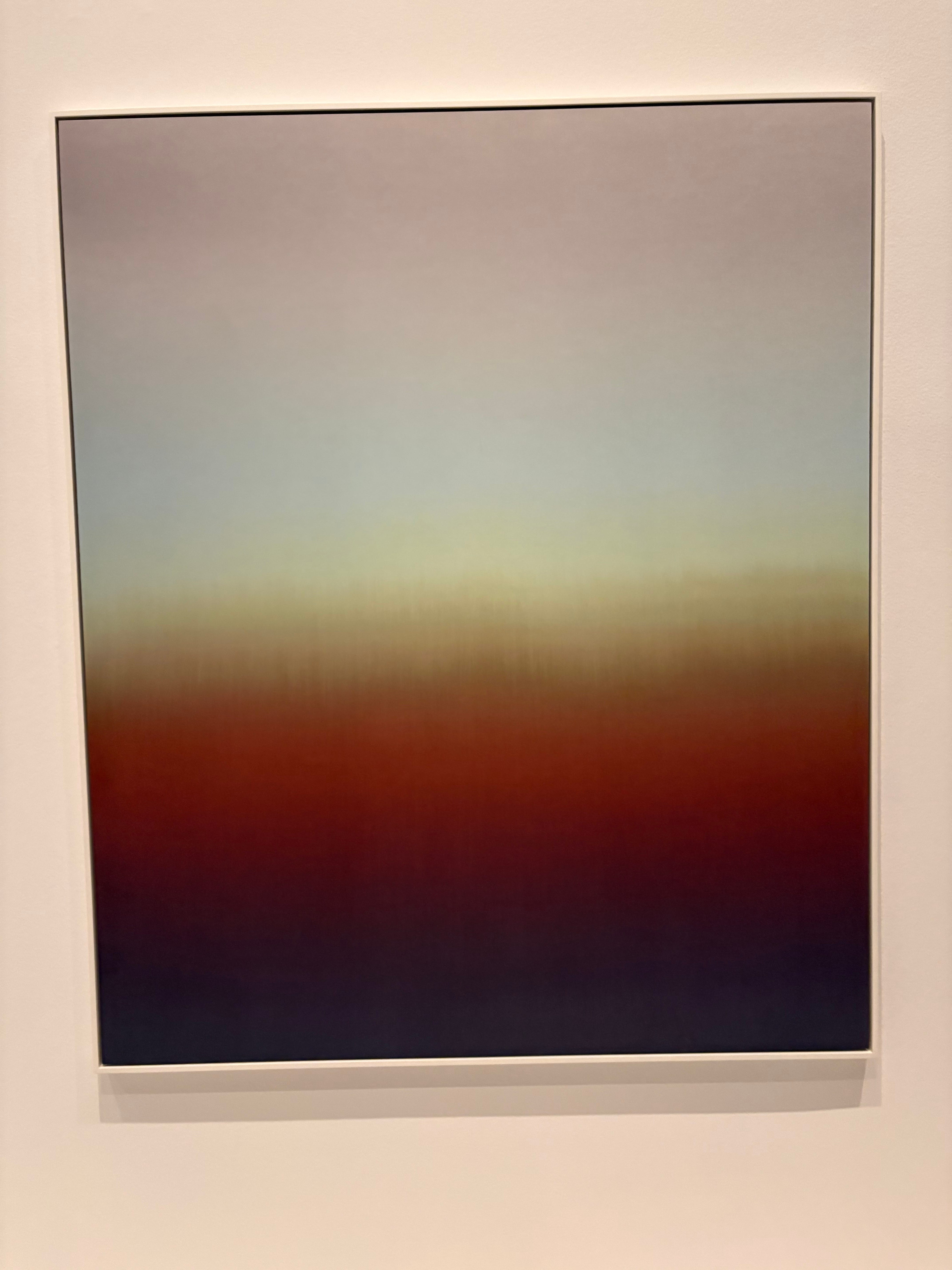
I was ultimately most moved by the exhibit description which read, in part:
“Identity, too, is vague and in constant flux, revealing all or some of its facets to ourselves and to others (Óscar Muñoz and Bertrand Lavier). Halfway between an uncertain memory of the past (Eva Nielsen) and a refusal to depict an immobile present (Mame-Diarra Niang), blurriness becomes a quest for identity.”
Blurriness is both a “quest for identity” and the nature of identity itself. We cannot fully know people, nor should we. Like people, the meaning in the piece above exists not in a detailed understanding of every part, but of an acceptance for the blurred whole.
The fact that grief and loss contains a necessary element of forgetting, as Wordsworth reminds us, is not in itself so regrettable insofar as we find meaning in the newfound blurriness of this person.
If you have lost someone, you know that, with time, you will forget the sound of their voice, the details of their features, the specifics of all your shared memories. Yet you also know that your perception of this person also fills out—what remains becomes much larger, much more representative, much more profound.
You may say that this blurriness is worse; worse than the clarity you could apprehend as they lived. It contains fewer multitudes. By definition, this person’s parts are less clear. But the parts that remain, and the blurred identity that forms is the point of grief. This is how relationships live on—perspectival notions of individual identities—rather than the people themselves.
This is what is at risk. Manufactured permanence means artificial clarity. It means distilling a person into what they have trained a chatbot, and not who they were to you.
When we use griefbots, we suffer a person’s absence less, but we unknowingly suffer the loss of what grief would teach us about who they were and who they are.
Pictures do this. Think of an ex partner for example. Looking back at pictures of this person gives a profoundly false sense of the person themselves, nor an accurate representation of your relationship. Were this person allowed to fade with memory, then that relationship and the truth of this person’s identity to you would distill over time.
Don’t get me wrong. Details are useful. Remembering is vital. But artificial memory resists the beautiful and cathartic act of letting go and the possibility that through this grief-filled haze you may find something new.
This brings me back, finally, to wizard portraits. It is not that these portraits may be misrepresentative, but that they offer an artificially permanent account of a person that should be properly grieved and partially forgotten.
The fact that this permanent account of the individual lives on means that their memory and values cannot be fully adopted or embodied in the living. Harry is not completely sure of his morals, nor need he be so long as he has this portrait of Dumbledore.
In truth, I’m shocked that this thorny annoyance with portraits in a series I read when I was 11 has manifested in such a long rant. I am equally shocked, however, at the very existence of the so-called Digital Afterlife Industry. It fills me with a disgust that is rooted in that same irk I felt 12 years ago.
The purpose of this piece, though, is not to rail against the industry or its perverse motives, but simply to reflect on what, inevitably, it will take from us.
I am not naive. This is a product that people will use. In the parts of life filled with pain, sorrow, and insecurity, AI will touch down quickest and grip us most effectively.
Like a drug, we will use it to delude ourselves into a more convenient and assuring reality. These delusions, unlike those induced by drugs, will be durable, faith-based, and incomprehensibly deep.
Relationships and love seem to supersede all attempts at quantification. Yet it is this ambiguity, I think, that will allow AI (like religion) to thrive.
Who knows—maybe someday I will be driven to use one of these griefbots. I hope not. But, then again, I do not know how I will act in this moment of pain and desperation. Do you?